Pura Vida Homepage

"Pura Vida", used by Costa Ricans, literally translated means "Pure Life." Contextually, it means "Full of Life" "Purified life", "This is living!", "Going great!" It is used as a greeting, a farewell, and to express satisfaction....Costa Ricans use the phrase to express a philosophy of strong community, perseverance, good spirits, enjoying life slowly, celebrating good fortune, whether small or large. (Wikipedia)


Welcome to the Pura Vida and crew website. Thanks for joining our adventure. Feel free to leave a comment or send us an e-mail. We love hearing from you...

Riding the Tide

Well, we’re finally anchored in Darwin, but not without an interesting final day on passage.  After talking to S/V Imagine on the SSB and realizing this might be our last chance to see them before they leave for Indonesia (and finally getting tired of creeping along at 2-2.5 knots) we finally turned on an engine.  We’d only accumulated about 4 engine hours since leaving Cairns, so why not?  Oh yeah, there were no more chips in our snack compartment either, so there was a building sense of urgency.

The last part of the passage into Darwin passes through the Van Diemen Gulf, a large, bay about 90 nm wide with openings at the northeast and west and the rest of its circumference formed by the Australian mainland in the south and east and Melville Island in the north.  The gulf is big and the mouths are relatively narrow and shallow, which means that when the large tides in this area ebb and flow, there’s quite a bit of current.  Life is a lot better when you’re running with the current instead of trying to fight it, so the ideal way to finish this passage is to let the incoming tide suck you into the gulf at the Dundas Strait, sail as fast as you can across to the west side and then let the outgoing tide spit you out through the Clarence Strait.  If your timing is really good, you’ll get out of the gulf just in time to let the next incoming tide push you down to Darwin.

I hadn’t planned any of this when I got up for my 3 am watch, just as we were nearing the Dundas Strait.  After six days at sea just taking what the winds provided, I wasn’t even sure what the state of the tide was going to be.  I soon found out, though.  We’d been warned that Cap Don could get pretty rough if you didn’t catch an incoming tide, but as we motorsailed by it at about 5 am and entered the Van Diemen Gulf, the water was incredibly calm and the boat speed kept climbing.  5 knots is a good average speed for us, 6 knots is great, and averaging 7 knots for a day is almost unheard of.  As the tide sucked us in, I watched the GPS speed climb above 8 knots and then above 9.  As it hovered at 9.9 I wondered if we’d make 10 and then it hit 10 and kept climbing.  We topped out at 11 knots, and stayed above 10 knots for well over a quarter of an hour.  The whole time, the boat was almost as still as if it was at anchor.

Australia only releases a few days of tide information at a time on the internet for free (as well as the whole year’s tides for a few locations) and if you want the rest you have to buy an expensive tide table book.  Luckily I’d been given some tide software by another cruiser that seemed to be reasonably accurate.  After obviously getting lucky on our way in, I was ready for more of the same and pulled up tide programs and charts on the laptop to try to plan the day.  As it turned out, we were able to time things almost perfectly and with the help of the second engine when the wind was light, we were able to make it all the way to Darwin before sunset while only fighting the current for a few hours of the trip.  From passing Cape Don until we anchored in Darwin, we covered 93.6 nautical miles in 11-12 hours for an average speed of about 8 knots (around 10 mph).  It really doesn’t take much to get you excited after a week at sea.

DSC_0507 The line of whitecaps ahead is the edge of a strong tidal rip.  The smoke is from a large brush-burning fire on the mainland.

DSC_0510 10.6 knots (This is the part where you say WOW! THAT’S REALLY FLYING!)

The only bad part of the day was hitting a rough patch of water in the gulf where the tide was running against a strong wind that we were sailing into.  We hadn’t had any rough seas for so long that we once again got caught with a hatch open and managed to soak our berth pretty well, including some electronics that we’re hoping will recover.  Lauren went right to work on it though, and after several hours of work she had it pretty much put back together by time we made it to Darwin.  She really is amazing.

S/V Imagine was still here when we arrived and after a quick dinner we had a great evening with them, getting their tips on Darwin and talking over experiences we’d had.  It was so nice to see them that I caught a second wind and even though I had gotten up at 3 am and they had to leave with the tide early in the morning, we didn’t get to bed until midnight.  Needless to say I had a great night’s sleep.

Twice Buzzed

Lat: 10 51.495′ S
Long: 132 40.233′ E

We’re beginning our 6th consecutive day at sea, and as cruisers often say on the SSB radio nets when checking in, "all is well on board". The last two days consisted of very comfortable, downwind spinnaker sailing. This was a welcome relief after a couple of days of uncomfortable beam seas that, combined with a bit of exhaustion from getting used to long night watches, had me occasionally wanting to stop the boat and get off (obviously not an option). The wind eased up as well, so we slowed down but didn’t mind. However, it has now slowed to a virtual halt, and I’m surprised we’re still able to sail (now with the main and jib). We’re only 150 miles out of Darwin, but it may take two days to get there at this rate. Dallas worked out that it would cost about $100 in diesel to motor there, so as long as we can sail, we will. In the meantime, we are in the process of drawing some firm conclusions about the meaning of life and such. (I’ll let Dallas fill you in on those details….ha ha.)

sunset One of several beautiful sunsets on this passage

It’s pretty unusual for anything too exciting to occur out here (hence the saying: sailing is 99% boredom, 1% sheer terror), but lately it has seemed that when it does, we are caught with our pants down, so to speak. The first incident of this on this passage was on Sunday when we had so much power in the house bank that Dallas thought we might as well flip on the fridge and make some ice. This sounded great to me, and by sunset, we had sufficient ice cubes for a cold drink. What better iced drink to have in calm seas than a cocktail, right? (believe it or not, also the skipper’s idea) Well, the first one was so good that Dallas decided to have another (I was on watch, he was headed to bed soon), and as he sipped on it, I went to check our course and discovered that according to the AIS, we were due to smack head-on into a ship! Of course we had 20 minutes before this was to occur — plenty of time to hail the ship (a tug towing a 600′ barge) on the radio and determine who would change course, but this is the first time that we have ever had to do this, so it was ironic that it occurred when we were the least alert.

dallas Ice is picture-worthy for us

The second incident happened yesterday. In the lighter winds, I decided to take the opportunity to have a bath in the deep blue sea. We were going 4 knots, which was just about perfect in terms of being able to hold on to the swim ladder without any trouble but still get a bit of a thrill. Anyway, no sooner had I come out of the water when a Customs plane approached for its daily fly-by! If they can read the hailing port from the stern of the boat, I’m sure they can….anyway, I quickly found my towel and headed for cover.

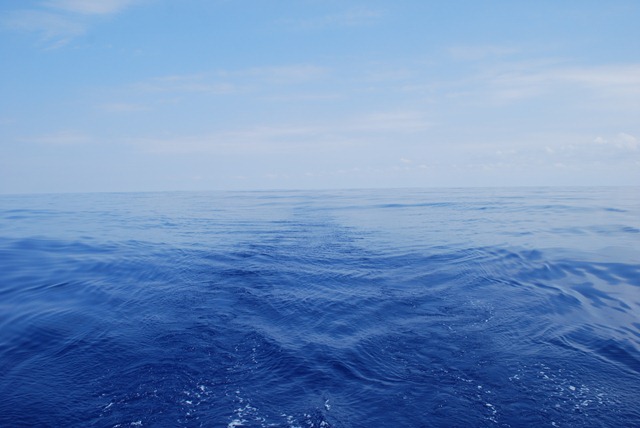
water Check out the wake running behind

The only other highlight of recent days to speak of (besides the dolphins that Dallas talked about) was that Dallas made his first loaf of bread yesterday — black olive and onion loaf. It turned out very, very well.

Hopefully our next post will be from Darwin…

Across the Gulf

Lat: 10 50.838′ S
Lon: 136 17.102′ E

I’ve just started my night watch at about 3am. Watches have changed quite a bit now that we’re on passage with just the two of us. We’ve adopted a system of longer night watches that’s closer to the way our friends on S/V Imagine do it. Lauren takes a night watch from 8pm or so until 2 or 3am — I get to go to bed early (I’m always sleepy anyway). I get up when she goes to sleep and am on watch until 8 or 9am when I get on the radio to listen to the nets and she wakes up and makes breakfast. I usually end up dozing off quite a bit between 9 and noon while she keeps an eye out and then we take turns watching through the afternoon and evening depending on who’s feeling like dozing and who’s awake.

Just as we were leaving Seisia, we thought we’d lost one of our favorite pieces of gear — the dana. The dana is basically a word processor. It has a full size keyboard and an 11-line LCD screen that lets us type blogs for almost no power (it uses 3 rechargeable AA batteries) instead of using the laptops. With just the two of us we have too much power, if anything, but with a larger crew, it’s pretty handy. Lately it’s been acting up, with keys that randomly stop working and then sometimes work again. It seemed hopelessly lost when "t", "y", and a couple of other keys absolutely refused to work yet again. I thought it would be worth taking apart since I used to design this sort of thing. Even though I don’t really have the tools on-board to properly troubleshoot and repair electronics, we got lucky. As soon as I opened the back cover I could see a loose keyboard cable. I guess all the shock and vibration from passages since Key West had worked the connector loose. Anyway, it’s back now.

DSC_0477 Most of our blogs start here

We thought the trip through the southern Arafura sea across the north edge of the Gulf of Carpenteria would be with following seas and winds from astern, but we’ve ended up with a fair amount of wind on the beam and pretty good sized beam seas that have been a little uncomfortable for the last couple of days. Uncomfortable seas means that Lauren and I spend a lot of the day laying down in the salon reading, listening to music, watching movies, or listening to audiobooks. It’s been a little warm, though and we’ve had to shut the hatches because the waves are large enough that occasionally the crest of a big one slaps up against the port side of the boat and the very top part of the wave gets thrown as a heavy shower over portions of the deck. Tired of being inside, I suggested this afternoon that we sit outside for a bit where it was sunny with a nice cool breeze. We were out there only a few minutes when I saw a large wave build up like a translucent light green wall beside us with a small gray body swimming quickly inside it — dolphins. It’s been a while since we’ve seen a pod of dolphins. These dolphins were smaller than the ones we’re used to seeing but were pretty playful, and the pod of 20 or so spent quite a while playing in the bow wave, darting back and forth, lining up in groups of 3-5, and swimming along just under the surface. It seems like one of their favorite games is to dart in from the side so that they’re swimming just inches in front of the bow and then to swim there in a small group of three or four as we surf down waves and have small bursts of acceleration. They were a lot of fun to watch until we caught a large, steep wave on the port hull again and Lauren and I got an unexpected salt water shower. Oh well, it was time to put on a new pair of shorts anyway.

We also got buzzed again today by an Australian Customs plane who then called us on the VHF to check on our details and itinerary. It’s really amazing how close they get. They could read the port of registration off the stern even underneath the dinghy and if you’re out on deck when they come by, you can see their faces in the cockpit. They really do make the US border security look like a joke. We’ve sailed to the Bahamas several times and never once been stopped by the USCG or customs; the one time we did try to clear customs and immigration properly we had to drive all the way over to their office at Port Everglades and try to catch them before the office closed. Granted, Australia doesn’t have a land border and doesn’t have to worry about immigrants from the east (they let the Kiwis in pretty freely), south (everyone in Antarctica volunteered to be there), or west (Africa is a whole ocean of rough water away). But, they do patrol their 1000-1500 miles of northern border waters incredibly well. We asked the Navy guy who we met in Cairns how many boats of immigrants get through and he said, "None — zero." At this point, immigrants just float out into the Torres Straits and wait to get far enough that the Australian Navy picks them up and takes them to Christmas Island for processing, with some hope of getting to the Australian mainland as legal residents. I asked him where the people filling these boats come from and he said they’re mostly from Iraq and Afghanistan and are seeking asylum. Hmmmmm. Who would start wars there that create so many refugees and then not volunteer to take any of them in? Must be those pesky Australians getting what they asked for again.

DSC_0494 Customs plane flying by

We had planned to stop in the Wessels, but we haven’t made the best time and are arriving in the middle of the night, so we decided to keep moving. The nights have been cloudy and incredibly black (we wouldn’t even be able to see the bow if the nav lights weren’t on), so it’s not really worth the risk to try a night approach, and we’re trying to make time for a longer stay in Bali anyway. At least the wind has less fetch now that we’ve neared Cape Wessel so the seas are calmer. It’s a welcome change from the steep 8-10-footers that were rolling in on our beam.

Grass!

Lat: 10 48.643′ S
Long: 141 43.436′ E

It’s Thursday afternoon, and we are sailing toward the Wessel Islands in pretty ideal conditions. The water just north of the Northern Peninsula Area (NPA) is a beautiful turquoise dotted with little green islands, and we are spinnaker sailing with 15 knots from the southeast.

We enjoyed our brief stay in Seisia. We lazed around on Tuesday morning, apparently still catching up after two nights at sea, and then went ashore for internet (high speed at the RV park office — oh yeah) and a bit of provisioning. That evening we went in search of an ant hill to photograph, and we didn’t have to walk too far to find some taller than us. (Dallas just had to show this city girl how to scoot through a barbed wire fence.) It really blows my mind how cooperative these tiny little ants must be to achieve something so large.

anthillYep, that’s an anthill!

We had already walked a fair distance toward the nearby metropolis of Bamaga and decided to try to hitch-hike the rest of the way to check out "the haps" at the tavern. We had only waited 5 minutes for a ride the day before but didn’t have any luck on this occasion, probably because it was almost completely dark! I can see how nighttime is not well suited for getting a lift from strangers. We’re new at this.

We stopped at the wharf on the way back to the boat and found several locals and holiday-makers fishing. We spoke to a really nice mother and son from Melbourne who showed me how to use a jigger to catch bait fish (there were hundreds of them swimming right next to the wharf). I also learned a new word from them to add to my ever-growing list of Aussie/Kiwi/British slang: "grass". No, they weren’t offering us illegal substances, they were simply saying how cool our trip around the world was — "that’s grass!" They were in the midst of a 6-week family holiday and had driven their 4×4 up through the center of Oz. Their two boys are able to get school credit for the blogs that they are writing along the way, which sounds like a great idea to me.

They told us about a traditional Aboriginal dance performance that was to take place the following night at the local fishing club, and after some deliberation, Dallas and I decided to stick around for another day to check it out. It turned out to be a good decision, not so much for the dancing (although it was cool) but for the time that we were able to spend with another Aussie, a 50-something liveaboard named Brett. He spent several years in the States, including a few years working as a pilot for Continental in Houston. As that is the port listed on the stern of our boat, he was naturally inclined to come by and say hello (while Dallas was working on the carburetor of the outboard again!). He brought over a few cold beers, and he and Dallas yarned away (see what I mean about the slang?) about everything boat-related, from the proper way to set the anchor to the loss of .3 amps for every amp put into the house bank (this was news to me). He was bright and down-to-earth and had a couple of hair-raising stories from his pilot days. He also had insight into the differences between American and Aussie cultures. For example, he raised his step-sons in Oz so that they would learn how to be self-sufficient (e.g., to fish and hunt) and then sent them to the U.S. to develop their real-world work ethic. Anyway, he was great company, and I could tell that Dallas was really pleased to have someone other than me to talk to for the first time in 10 days!

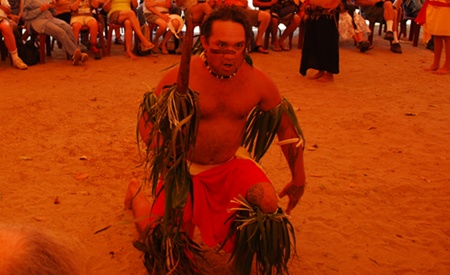
Regarding the dance performance last night, it was in fact very traditional, but the dancers were young boys (aged 6 or 7) and teenage girls (aged 10-17), so it wasn’t like watching the professionals in Polynesia. I tried talking to one of the teenage girls after the performance about the absence of guys. She was busy texting and just said "they’re at home". The Aboriginal situation here is so complex and long-standing that I would not do it justice by trying to describe it in a short blog, but what I’ve heard about the history of the government’s attempts to remedy the problem (e.g., the "Stolen Generations", the massacre in Tasmania) is pretty shocking.

danceTraditional Aboriginal dance

We have about 300 miles to go to the Wessels, which are supposed to be pristine and beautiful. We haven’t seen any awe-inspiring, natural beauty for a whole 4 or 5 days (must be a record!), so we’re looking forward to it.

Over The Tip

We’ve made it over “The Tip”, as the locals call Cape York, the northernmost point of the Australian mainland.  We covered the 320+ nm distance from Lizard Island to Cape York in about 48 hours, giving us an average speed of better than 6.6 knots, which is probably a record for us.  All we had to do is unfurl the jib a couple minutes after leaving Lizard Island and then gibe occasionally when our course changes through the GBR caused the following winds to come from the opposite quarter.  We had plenty of wind the whole time, with the strongest winds coming the second night – sustained 40 knots for a bit with gusts over 50 knots.  The boat really did well, though, and the reefs and islands kept the seas from getting as big as they would have if we’d been offshore, so overall we were pretty comfortable.

Passing through the Torres Strait is often a bit of a nightmare for people because of the strong tidal currents and shipping traffic, but we were fortunate to have a great passage.  We were planning to anchor at Albany Island, just before the straits to get some sleep and wait for good tide conditions and daylight, but our timing was perfect, so we just kept sailing.  We arrived just after sunrise, with the wind at our back and the tides in our favor as well.  We were arriving just after a low tide, so the current would be running with both us and the wind (against us would have slowed us and against the wind would have resulted in steep seas).  It was also a half moon, so the tides (and currents) weren’t as extreme, and this was the second high tide of the day, which was much smaller (again, less current) than the day’s earlier high tide.  Pretty good luck overall.  As we sped toward the Cape doing 7 knots on just the jib, we enjoyed sunny skies and light seas that left the boat feeling like it was at anchor.

DSC_0327 Cape York about a mile away between Ecobar (l) and York (r) Islands

By early afternoon, we’d entered the Endeavor Strait and dropped anchor at Seisia (SAY-see-uh) where we were planning to pick up a few fresh groceries.  Seisia is our first real outback experience, and our first day here has been an interesting one.  The mainland is covered in brush and red dirt.  As soon as we went ashore we started seeing 4×4s with snorkels for crossing outback rivers and it seemed like half the men were wearing the stereotypical Aussie outback hats (think Crocodile Dundee).  Over half of the community of Seisia consists of an RV campground with 16 sites.  A wharf where a supply ship and ferry stop, a grocery store, a gas station, mechanic/junkyard, and a few houses and trailers make up the rest of the greater metropolitan area.  There are two common signs around town.  One is posted at the supermarket and gas station and states that by order of the local council, no children will be served between 9am and 3pm Monday through Friday (apparently school is really no fun here).  The second one is an ad for a local politician that says “No wild rivers without our consent”.  We’re still trying to figure out that that one means.

DSC_0345 The “tinnie” (aluminum boat) on the 4×4 is pretty common

We decided to try hitching a ride to Bamaga (BAM-uh-guh seems to be close), a few miles away, and after watching some free range horses cross the road in front of us, we were picked up by a couple of women in a youth club truck who informed us that the giant piles of dirt we’d seen on an island on the way in and that we were passing in the truck were anthills.  We saw one on the way that was about 7 feet high and 3 feet or so wide at the base.  The ants aren’t anything special in terms of their size, but the anthills are something to see.

DSC_0348 Hitching is easy work here – the place is small and people are friendly

Bamaga is something of the local big city, with a larger grocery store, a bar, a bakery, and a general store, a resort, and a post office.  The largest and nicest buildings in Bamaga seem to be the local government and unemployment offices.  We asked about some internet access where we could use our computer and it turns out that there are only two internet cafes/hotspots in the 5 communities here.  It was definitely starting to feel more like the islands than a first-world country.  After checking prices at the grocery store (try $7.50 for a tube of Pringles) we wandered over to the bar.  Of course they were playing MTV, just to make sure that even the most remote places of the world can recognize Brittney Spears and her latest #1 video.  The rules posted in the bar were numerous and seemed to indicate that drinking was a bit of a problem, presumably primarily with the local aborigine population.  There was a list of bad behavior, complete with the associated ban times for each offence (e.g., refusing to leave when asked is a 3 month ban), a notice that the associated drive-though liquor store would no longer be serving patrons on foot, rules against falling asleep and begging for money, cigarettes, or beer, and a list of the limit for in-bar and takeaway alcohol purchases.  I took a moment to use the restroom and found something I’d never seen before – a stack of bags to vomit in.  Apparently this is a big enough problem that the bar has purchased the bags and put a dispenser in the bathroom.  The funniest part is that there are detailed instructions on the bags about how to vomit in them and then throw them away, but all the instructions are printed backwards, as though you’re supposed to read them with your rearview mirror.  Of course there’s no mirror in the bathroom and the bags are presumably for the severely intoxicated.  Hopefully they can either backwards even when drunk or somehow manage it without detailed instructions.  Needless to say, we’re disappointed to be here on a Monday afternoon instead of a weekend night when we could apparently expect to be in for some pretty entertaining people-watching.

DSC_0352 One of my all-time favorite signs

DSC_0358 The V-BAG

We eventually met a local islander/aborigine named Noel (NOLE) who had a lot of interesting stories about life here in the far north.  He joined us for dinner on the boat, which was delayed just a bit by having to remove and clean the carburetor again.  Apparently the islands between here and Papau New Guinea were populated by people now called islanders who were different in terms of language and cultural from the aborigines of the mainland, although some intermixing did occur.  For instance, Noel’s Dad is an islander from Thursday island, while his mother is from the mainland.  When we asked him how many brothers and sisters he had, he said “heaps” – some in each of the local communities.  Many of his stories were about how the natives put meat on the table.  They hunt dugongs (manatees) by simply taking a dinghy out and drifting along until the curious dugong comes nearby and then they spear it and take it back with a larger dinghy.  Lobsters are plentiful at Cape York itself, where they brave the rough seas and strong currents to freedive and catch them.  Sea turtles are plentiful and are taken occasionally as well, but only a couple of fish can be speared at a time before sharks become a risk.  Last night Noel was planning to go crabbing with friends at midnight, when the moon rises and the crabs apparently come out to forage on the riverbank.  Wild cows and bulls can be shot near Weipa (a five hour boat ride).  Apparently most of the livestock ranges free, but the cows and bulls with no brands are wild and for the taking.  In some places they’re right up on the beach and they’re able to shoot them from the boat, but if they go to hide in the dense, impenetrable scrub, they use another trick.  They start a grass fire and burn a large area near the edge of the scrub.  A couple of days later, green shoots of grass appear in the burned areas and the cows and bulls, who have a serious craving for fresh green grass, wander out just before sunrise to enjoy the delicacy.  That’s when they become the delicacy for friends and family.  Kangaroos are hunted as well, but Noel says that even though croc tail tastes like chicken they generally don’t hunt it because it’s too dangerous.  He’s seen a man get killed by a croc.  Apparently the guy was a long time croc hunter who risked swimming from a river shore to a waiting ferry at night and only made it part way.  Noel and others found his body underwater where the croc had brought it back to stash it and eat it later.  Crocs are apparently protected now, but it sounds like there are plenty of people who still try to kill them when possible to avoid becoming prey at some point in the future.  After all the croc stories and the strong currents here I was glad that the repaired outboard ran well when I dropped Noel off at shore to go crabbing.  In the dark, the wharf lights showed at least 20 people fishing and pulling squid to make calamari.

DSC_0359 Noel

Noel also said that many people believe there are “wild people” (aborigines living in the traditional way) out in the bush.  One look at a map of the area makes it clear there’s plenty of unoccupied space and there have certainly been plenty of reasons for mistrust between the natives and whites in the past.  He says sometimes when they’re out in the bush acting as rangers or hunting, they find unexplained fires that are still warm, see smoke, or see people in the distance.  That one may be a tall tale, but this place is definitely a far cry from Cairns, with its blocks of tourist shops and restaurants and fleet of boats that carry hundreds of tourists daily.

www.puravidasail.com has had 55708 visits